Please briefly explain why you feel this question should be reported.

Please briefly explain why you feel this answer should be reported.

Please briefly explain why you feel this user should be reported.

Sign InSign Up

AccountingQA

AccountingQA Logo AccountingQA Logo

AccountingQA Navigation

  • Home
  • Ask Questions
  • Write Answers
  • Explore
  • FAQs
Search
Ask A Question

Mobile menu

Close
Ask a Question
  • Home
  • Questions
    • Most Visited
    • Most Active
    • Trending
    • Recent
  • Follow
    • Categories
    • Users
    • Tags
  • Write an Answer
  • Badges & Points
  • Request New Category
  • Send a Suggestion
  • Search Your Accounting Question..

  • Most Visited
  • Most Voted
  • Followed Questions
  • Most Answered
  • No Answers

AccountingQA Latest Questions

A_Team
A_Team
In: 1. Financial Accounting > Subsidiary Books

why cash book is called journalised ledger?

  • 1 Answer
  • 0 Followers
Answer
  1. Vijay Curious M.Com
    Added an answer on August 22, 2021 at 7:28 am

    Cash Book is called a journalized ledger because it is considered to be both a journal as well as a ledger. As you know Cash Book is a subsidiary book. But like a journal, the transactions in the Cash Book are recorded in it for the first time from the source documents/vouchers. Hence it is considerRead more

    Cash Book is called a journalized ledger because it is considered to be both a journal as well as a ledger.

    As you know Cash Book is a subsidiary book. But like a journal, the transactions in the Cash Book are recorded in it for the first time from the source documents/vouchers. Hence it is considered to be a journal for all cash transactions.

    Cash Book can also be viewed as a Cash A/c because all transactions involving cash are recorded in it. It provides a summary of cash transactions. Hence it is considered to be a ledger account for cash transactions.

    Since Cash Book is both a journal and ledger, you can very well call it a ‘journalized ledger’.

    See less
    • 0
    • Share
      Share
      • Share on Facebook
      • Share on Twitter
      • Share on LinkedIn
      • Share on WhatsApp
Anushka Lalwani
Anushka Lalwani
In: 1. Financial Accounting > Subsidiary Books

Can someone share petty cash book format?

  • 1 Answer
  • 0 Followers
Answer
  1. ShreyaSharma none
    Added an answer on August 27, 2022 at 10:52 pm
    This answer was edited.

    Introduction & Definition Firstly, let's see what the term 'petty cash book' means. The word ‘petty’ means small. A petty cash book is identical to a cash book, maintained to record the small expenses of a business like stationery, postage, stamps, carriage, etc. The cash received by a petty casRead more

    Introduction & Definition

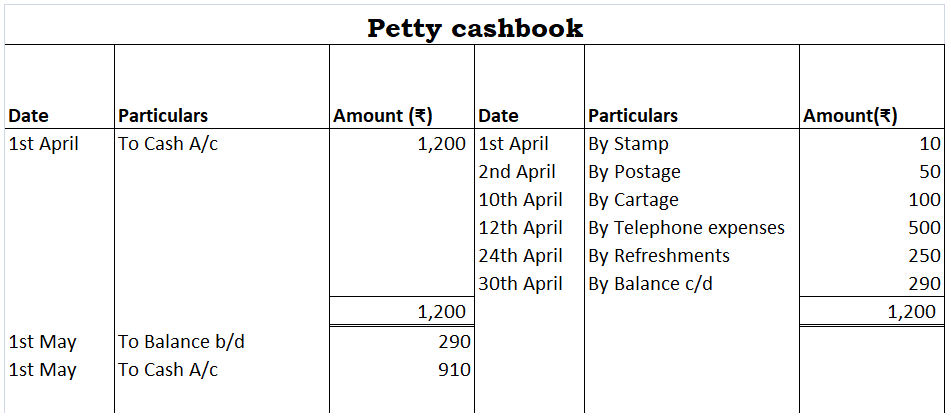
    Firstly, let’s see what the term ‘petty cash book’ means. The word ‘petty’ means small. A petty cash book is identical to a cash book, maintained to record the small expenses of a business like stationery, postage, stamps, carriage, etc. The cash received by a petty cashier is recorded on the debit/ receipt side whereas, the money he pays is recorded on the credit/ payment side. The difference between the sum of the debit and credit items represents the balance of the petty cash in hand.

    The reason the petty cash book is maintained is that it records small expenses that are inconvenient or too small to be registered in the cash book. This is also called a simple petty cash book. Just like a cash book is maintained by the accountant, the petty cash book is maintained by a petty cashier.

    When it comes to the format, there are two types of petty cash book formats. They are-

    1. Simple Petty Cash Book
    2. Analytical Petty Cash Book

    We have been discussing the simple petty cash book so far. Thus,

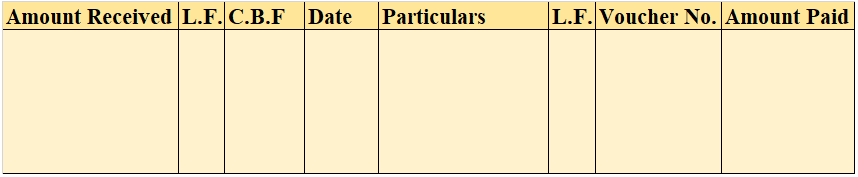
    Format of Simple Petty Cash Book


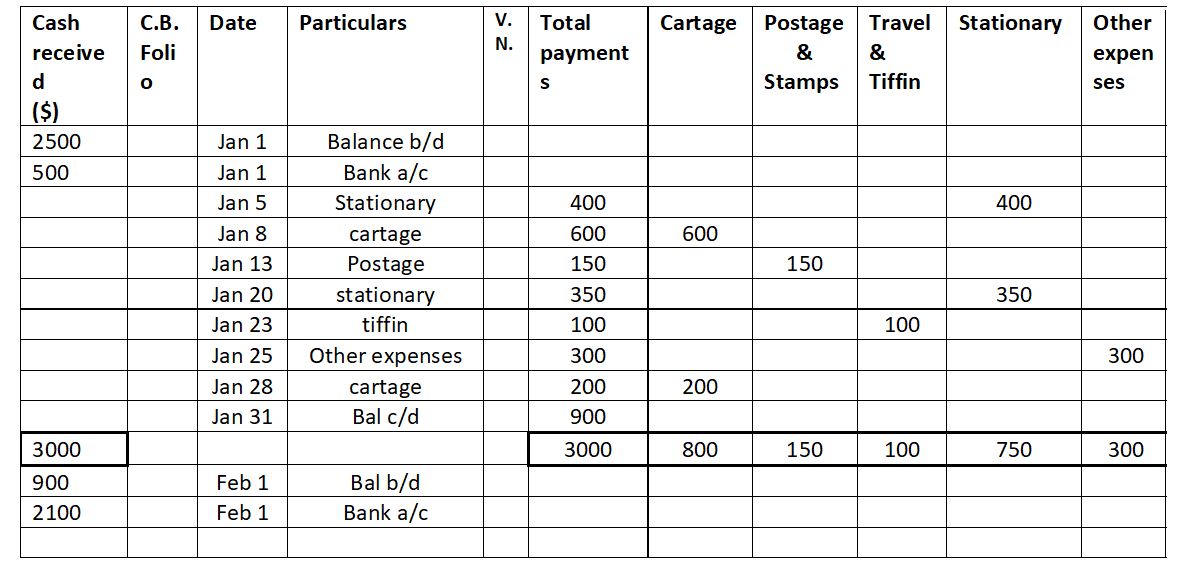
    Analytical Petty Cash Book

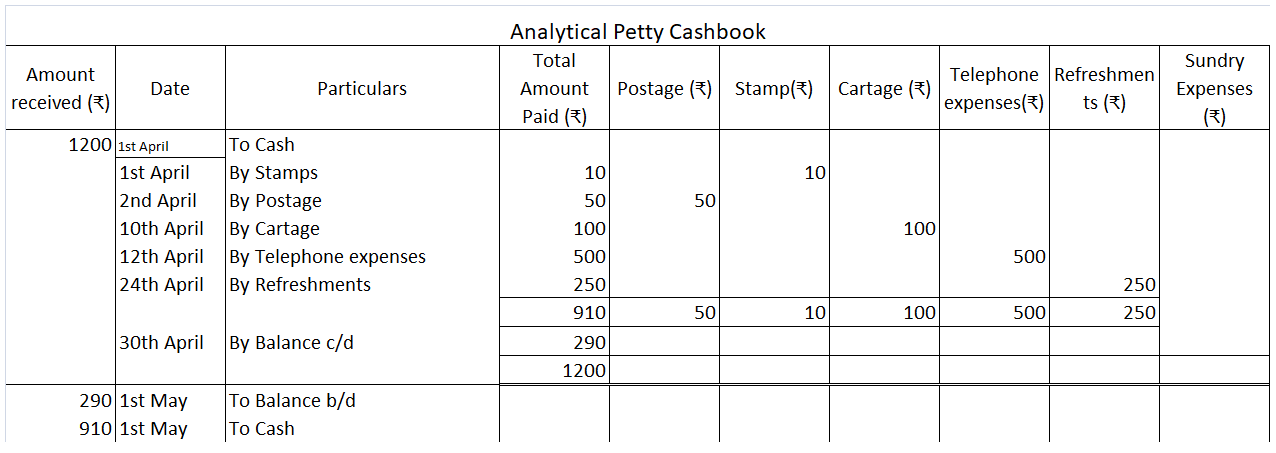
    The analytical petty cash book has numerous columns for the recording of monetary transactions. In the analytical petty cash book, there are pre-existing columns for the usual expenses that are recorded frequently in the business which makes it easier for a business that has daily expenses for food, stationery, postage, etc. They’ll be having individual columns. It has numerous columns in it for the recording of expenses in it.

    The key advantages of an analytical petty cash book are-

    • One of the major key advantages is that the analytical petty cash book due to its format and structure saves time.
    • The other advantage is that it helps the business in easy comparisons.
    • It requires lesser time in recording.


    Format of Analytical Petty Cash Book


    See less
    • 0
    • Share
      Share
      • Share on Facebook
      • Share on Twitter
      • Share on LinkedIn
      • Share on WhatsApp
Jayesh Gupta
Jayesh GuptaCurious
In: 1. Financial Accounting > Subsidiary Books

What is the meaning of unfavourable balance as per cash book?

  • 1 Answer
  • 0 Followers
Answer
  1. prashant06 B.com, CMA pursuing
    Added an answer on August 21, 2021 at 4:10 pm
    This answer was edited.

    Unfavorable balance as per cash book generally means credit balance in the cash book. This is also known as bank overdraft. Making the above definition more clear, unfavorable balance or bank overdraft means an excessive amount of cash withdrawn than what is deposited in the bank. Simply it is the lRead more

    Unfavorable balance as per cash book generally means credit balance in the cash book. This is also known as bank overdraft.

    Making the above definition more clear, unfavorable balance or bank overdraft means an excessive amount of cash withdrawn than what is deposited in the bank. Simply it is the loan taken from the bank. When there is an overdraft balance the treatment is just the opposite of that of favorable balance.

    Generally for business overdraft occurs when there is immediate or emergency funding for the short term. This can be seen for small and medium-sized businesses. This is considered to be convenient for these businesses because there is no requirement to pay interest on the lump-sum loan, only have to pay interest on the fund you use. Generally linked to an existing transaction account.

    To reconcile this we need to prepare a Bank reconciliation statement. The procedure of preparing BRS under unfavorable conditions is as follows

    • If we start from the cash book balance then “ADD” all the transactions resulting in an increase in the passbook. “DEDUCT” all the transactions that resulted in a decrease in the balance of the passbook. Then the net overdraft balance should be the same as in the passbook.
    • If we start from the balance as per the passbook then “ADD” all the transactions resulting in an increase in the balance of the cashbook and “DEDUCT” all the transactions related to a decrease in the balance of the cash book. The net overdraft balance as per the passbook should reconcile with the cash book.


    Let us take one example considering one of the above conditions.

    The cash book of M/s Alfa ltd shows a credit balance of Rs 6,500.

    • A Cheque of Rs 3,500 was deposited but not collected by the bank.
    • The firm issued a cheque of Rs 1,000 but was not presented for payment.
    • There was a debit balance in the passbook of Rs 200 and Rs 400 for interest and bank charges.


    Bank Reconciliation Statement

    Particulars Add Deduct
    1. Balance as per cash book 6,500
    2. Cheque issued but not yet presented 1,000
    3. cheque deposited but not yet credited by the bank 3,500
    4. bank and interest charges 600
    Balance as per passbook (overdraft) 9,600
    10,600 10,600
    See less
    • 0
    • Share
      Share
      • Share on Facebook
      • Share on Twitter
      • Share on LinkedIn
      • Share on WhatsApp
Ishika Pandey
Ishika PandeyCurious
In: 1. Financial Accounting > Subsidiary Books

What is bills payable and bills receivable book ?

  • 1 Answer
  • 2 Followers
Answer
  1. SidharthBadlani CA Inter Student
    Added an answer on February 5, 2023 at 12:58 pm

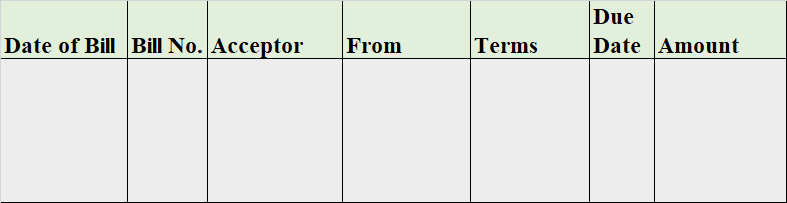
    A bills receivable book is a subsidiary book that shows the details of various bills receivables drawn on customers. It shows the amount, due date, date when the bill was drawn, name of the acceptor, and various other details pertaining to each bill. A bills payable book is a subsidiary book that shRead more

    A bills receivable book is a subsidiary book that shows the details of various bills receivables drawn on customers. It shows the amount, due date, date when the bill was drawn, name of the acceptor, and various other details pertaining to each bill.

    A bills payable book is a subsidiary book that shows the details of various bills that suppliers have drawn on the business. It shows the amount, due date, date when the bill was drawn, name of the drawer and various other details pertaining to each bill.

    The total of both these books is ultimately transferred to the general ledger. From there, it is used in drafting the balance sheet.

    Importance of bills receivable and bills payable books

    Bills receivable books help us know the amount that each customer is liable to pay us on specific dates while bills payable books help us know the amounts that we have to pay our various suppliers on certain dates.

    Together these books help us handle our cash flows in an efficient manner.

    We can evaluate our credit cycle. Bills receivable books help us avoid bad debts while bills payable books help us to avoid defaults.


    Difference between bills receivable and bills payable

    These are the primary differences between bills payable and bills receivable:

    • Bills receivable represent the amounts that the business is to receive from customers while bills payable represent the amounts that the business has to pay to suppliers.
    • Bills receivable are recorded as an asset in the balance sheet while bills payable are recorded as a liability.
    • Bills receivable are drawn by the business on the customers while the bills payable are drawn by the suppliers on the business.
    • Bills receivable are the outcome of credit sales while bills payable are the outcome of credit purchases.
    • Bills receivable result in an inflow of cash while bills payable result in an outflow of cash.
    • The dishonor of a bill receivable is recorded as an increase in the debtors of the business. Default on payment of bills payable may occur either because the business has become bankrupt or the business may record an increase in creditors.

    We can conclude that both bills receivable and bills payable books are subsidiary books. Bills receivable shows the details of every bill that the business has drawn on each credit customer. Bills payable show the details of every bill that each credit supplier has drawn on the business.

    See less
    • 0
    • Share
      Share
      • Share on Facebook
      • Share on Twitter
      • Share on LinkedIn
      • Share on WhatsApp
Karan
Karan
In: 1. Financial Accounting > Subsidiary Books

What are secondary books of accounts?

  • 1 Answer
  • 0 Followers
Answer
  1. Ayushi Curious Pursuing CA
    Added an answer on October 19, 2021 at 7:56 am
    This answer was edited.

    Secondary books of accounts are most commonly known as subsidiary books of accounts or day books. They are prepared to record the same type of journals in an ordered manner in a special book. They are nothing, but special journals. Recording all the journals entries in a single journal and these posRead more

    Secondary books of accounts are most commonly known as subsidiary books of accounts or day books. They are prepared to record the same type of journals in an ordered manner in a special book. They are nothing, but special journals.

    Recording all the journals entries in a single journal and these posting them to different ledgers can be very difficult if the number of transactions is huge.

    So, recording the same type of transactions in a special journal proves to be useful in efficient book-keeping and also information retrieval.

    There are eight subsidiary books:

    1. Cashbook – It is three types. (a) Single column cash book – It records only cash receipts and cash payments. (b) Double column cash book – Apart from cash receipts and cash payments, it also records bank receipts and bank payments. (c) Triple column cash book – It additionally records the discount allowed and discount received.
    2. Purchase book – It records all the credit purchases except the purchase of assets.
    3. Sales book – It records all the credit sales except the sale of assets.
    4. Purchase return book – It records all the transactions related to the return of purchased goods.
    5. Sale return book – It records all the transactions related to the return of goods from customers.
    6. Bills receivable book – It records the particulars of all the bills drawn in favour of the business.
    7. Bills payable book – It records the particulars of all the bills drawn in the name of the business.
    8. Journal proper – It records those transactions which cannot be recorded in any of the above-mentioned books. For example, entry related to depreciation charged on assets.


    Also, there are a few more things to know:-

    1. Subsidiary books may look like ledger accounts but they are not ledgers. Ledgers are books of final entry and subsidiary books can be said to be the book of intermediate entry and are not but special journals.
    2. Once transactions are recorded in the subsidiary books, they are then posted to the ledgers.
    See less
    • 0
    • Share
      Share
      • Share on Facebook
      • Share on Twitter
      • Share on LinkedIn
      • Share on WhatsApp
Karan
Karan
In: 1. Financial Accounting > Subsidiary Books

What is a petty cash book?

  • 1 Answer
  • 0 Followers
Answer
  1. Ayushi Curious Pursuing CA
    Added an answer on October 31, 2021 at 9:43 am
    This answer was edited.

    Let’s understand what a cashbook is: A petty cash book is a cash book maintained to record petty expenses. By petty expenses, we mean small or minute expenses for which the payment is made in coins or a few notes like tea or coffee expense, bus or taxi fare, stationery expense etc. Such expenses areRead more

    Let’s understand what a cashbook is:

    • A petty cash book is a cash book maintained to record petty expenses.
    • By petty expenses, we mean small or minute expenses for which the payment is made in coins or a few notes like tea or coffee expense, bus or taxi fare, stationery expense etc.
    • Such expenses are numerous in a day for a business and to account for such small expenses along with major bank and cash transactions may create an extra hassle for the chief cashier of a business.
    • So, the cash is allocated for petty expenses and a petty cashier is appointed and the task of recording the petty expenses in the petty cashbook is delegated to him.

    The manner in which entries are made

    When cash is given to the petty cashier, entry is made on the debit side and in the petty cashbook and credit entry in the general cashbook.

    Entries for all the expenses are made on the credit side.

    Generally, the petty cashbook is prepared as per the Imprest system. As per the Imprest system, the petty expenses for a period (month or week) are estimated and a fixed amount is given to the petty cashier to spend for that period.

    At the end of the period, the petty cashier sends the details to the chief cashier and he is reimbursed the amount spent. In this way, the debit balance of the petty cashbook always remains the same.

    Format and items which appear in the petty cashbook

    The format of the petty cashbook depends upon the type of petty cash book is prepared and the items appearing in it are nothing but petty expenses. Let’s see an example:-

    A business incurred the following petty expenses for the month of April:-

    1. Stamp – Rs. 10
    2. Postage – Rs. 50
    3. Cartage- Rs. 100
    4. Telephone expense – Rs. 500
    5. Refreshments – Rs. 250

    Now we will prepare two types of cashbooks:

    • Ordinary Petty Cashbook:

    Here, the Petty cash book is of the same format as the general cash book.

    The cash allocated for petty expenses is recorded on the debit side of the petty cash book and on the credit side of the general cash book.

    • Analytical Petty Cashbook

    Here, there are separate amount columns for each type of expense. As the name suggests, this type of petty cashbook helps to analyse the petty cash spending on basis of the type of expense.

    See less
    • 0
    • Share
      Share
      • Share on Facebook
      • Share on Twitter
      • Share on LinkedIn
      • Share on WhatsApp
Simerpreet
SimerpreetHelpful
In: 1. Financial Accounting > Subsidiary Books

When a petty cash book is kept there will be

A) No entries made at all in the general ledger for items paid by petty cash B) The same number of entries in the general ledger. C) Fewer entries made in the ...

  • 1 Answer
  • 0 Followers
Answer
  1. AbhishekBatabyal Helpful Pursuing CA, BCOM (HONS)
    Added an answer on November 1, 2021 at 12:02 pm
    This answer was edited.

    The correct option is D) Fewer entries in the general ledger To understand why option D is correct, we need to understand the concept. Petty cashbook is a special cashbook prepared for recording petty or small cash expenses. The benefit is that the chief cashier can focus on large cash and bank tranRead more

    The correct option is D) Fewer entries in the general ledger

    To understand why option D is correct, we need to understand the concept.

    • Petty cashbook is a special cashbook prepared for recording petty or small cash expenses.
    • The benefit is that the chief cashier can focus on large cash and bank transactions and there are fewer transactions in the main cashbook.
    • The petty cashier is provided with a fixed amount for a month or week and is reimbursed the amount spent at the end of the period after he sends the details of expenses to the chief cashier.
    • There are entries for the transfer of cash to the petty cashier in the main cashbook only.

    Option A ‘No entries made at all in the general ledger for items paid by petty cash ‘ is wrong. It is not possible to omit entries of petty expense just because there is a petty cashbook. There will be entries related to:

    • The cash is given to the petty cashier in a fixed amount or the amount spent as petty expenses during the month or week.

    Petty cash A/c  Dr.        Amt

        To Cash A/c                   Amt

     Option (B) ‘The same number of entries in the general ledger is wrong because there can never be the same number of entries as all the petty expenses are recorded in the petty cashbook and only the entries for transfer of cash to the petty cashier is recorded in the main cash book.

    Option D ‘More entries made in the general ledger​’ is wrong because the number of entries actually reduce as only petty cash transfer entries are recorded in the main cashbook instead of numerous entries of petty cash transactions.

    See less
    • 0
    • Share
      Share
      • Share on Facebook
      • Share on Twitter
      • Share on LinkedIn
      • Share on WhatsApp
Aadil
AadilCurious
In: 1. Financial Accounting > Subsidiary Books

What is sales return book format?

  • 1 Answer
  • 0 Followers
Answer
  1. Karan B.com and Pursuing ACCA
    Added an answer on December 4, 2021 at 1:02 pm

    In accounting, sales returns are the goods returned by the customer to the seller. This can be due to goods delivered is damaged or defective. A return can also be due to late delivery, or the wrong items being sent to the buyer. Sales return is a subsidiary book in which all the details are recordeRead more

    In accounting, sales returns are the goods returned by the customer to the seller. This can be due to goods delivered is damaged or defective. A return can also be due to late delivery, or the wrong items being sent to the buyer.

    Sales return is a subsidiary book in which all the details are recorded for the goods returned which were sold on credit. It is also known as return inwards.

    Accounting for Sales Return

    Whenever there is a sale return, the seller will debit the sales return account and credit the debtor’s account. The total amount of sales returns is deducted from the gross sales for the period giving the figure for net sales. Debtor’s account is credited because the amount receivable from debtors will reduce.

    The sales return is a contra account to the sales.

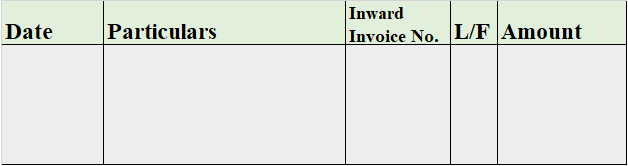
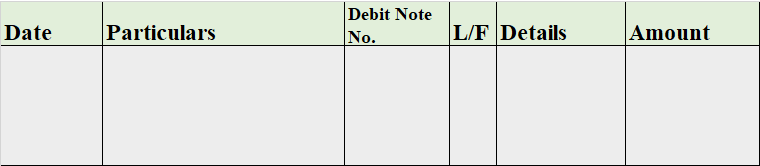
    Format of sales return book:

    In the above format, a credit note is a statement prepared by the seller and sent to the buyer. In this statement, all the details are mentioned in respect of the goods sent by the buyer and are an indication that the buyer’s account is credited in respect of the goods received.

    For example, Mr. A sold goods to Mr. B costing Rs 50,000 on 1 December. On 5 December, goods amounting to Rs 15,000 were found defective and were returned immediately to Mr. A.

    Mr. A will account for this in the following way:

    See less
    • 0
    • Share
      Share
      • Share on Facebook
      • Share on Twitter
      • Share on LinkedIn
      • Share on WhatsApp
Bonnie
BonnieCurious
In: 1. Financial Accounting > Subsidiary Books

Can you show bills payable book format?

  • 1 Answer
  • 0 Followers
Answer
  1. GautamSaxena Curious .
    Added an answer on July 19, 2022 at 5:52 pm
    This answer was edited.

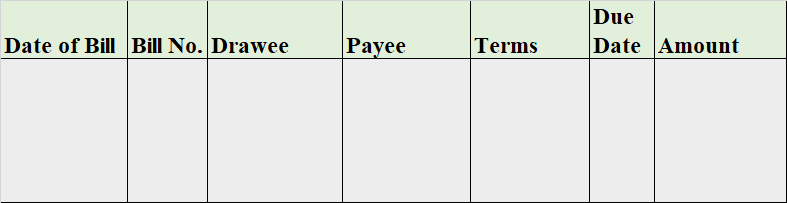
    Bills Payable Book Bills payable book, also known as a B/P book is a subsidiary or secondary book of account in which transactions relating to bills of exchange are recorded. It includes the recording of bills that are payable by a business. In a business where the number of bills exchanging hands iRead more

    Bills Payable Book

    Bills payable book, also known as a B/P book is a subsidiary or secondary book of account in which transactions relating to bills of exchange are recorded. It includes the recording of bills that are payable by a business.

    In a business where the number of bills exchanging hands is large in number, it is very useful, as it is tough to journalize all the bills drawn. A bills payable account generally has a credit balance as it is supposed to be paid at maturity and be a liability.

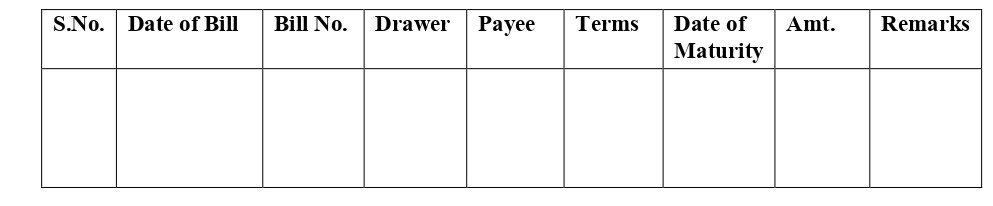
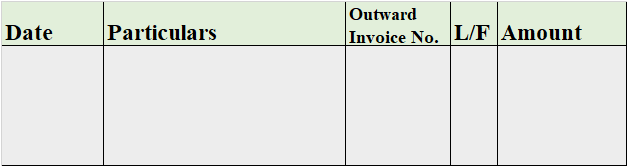
    Format for B/P book

    • The person, who draws the bill of exchange, is called a “drawer”.
    • The customer, on whom it is drawn, is called a “drawee” or an “acceptor”.


    Bills Payable A/c

    See less
    • 0
    • Share
      Share
      • Share on Facebook
      • Share on Twitter
      • Share on LinkedIn
      • Share on WhatsApp
Anushka Lalwani
Anushka Lalwani
In: 1. Financial Accounting > Subsidiary Books

Simply petty cash book is like a

A. Cash Book B. Statement C. Journal D. None of These

  • 1 Answer
  • 0 Followers
Answer
  1. Akash Kumar AK
    Added an answer on November 19, 2022 at 2:42 pm
    This answer was edited.

    The correct option is A) Cash book let's understand what is petty cash book: A petty cash book is a cash book maintained to record petty expenses. Petty expenses, mean small or minute expenses for which the payment is made in coins or a few notes or which are smaller denominations like tea or coffeeRead more

    The correct option is A) Cash book

    let’s understand what is petty cash book:

    • A petty cash book is a cash book maintained to record petty expenses.
    • Petty expenses, mean small or minute expenses for which the payment is made in coins or a few notes or which are smaller denominations like tea or coffee expenses, postage, bus or taxi fare, stationery expenses, etc.
    • The person who maintains the petty cash book is known as the petty cashier.
    • It is a simple process that helps organizations by focusing on major transactions as petty cashiers handle all small transactions.


    Generally, the petty cashbook is prepared as per the Imprest system. As per the Imprest system, the petty expenses for a period (month or week) are estimated and a fixed amount is given to the petty cashier to spend for that period.

    At the end of the period, the petty cashier sends the details to the chief cashier and he is reimbursed the amount spent. In this way, the debit balance of the petty cashbook always remains the same.


    The petty cash book has two columns in which

    • Cash received is recorded in the Left column i.e, “Receipts” or “Debit” column.
    • Cash payments are recorded in the Right column i.e, “Payment” or “Credit” column.


    Balance of Petty cash book

    The balance of petty cash book is never closed and their balances are carried forward to the next accounting period which is considered one of the most significant qualities of an asset whereas Income doesn’t have any opening balance and their balances get closed at the end of every accounting year.

    A petty cash book is placed under the head current asset in the balance sheet. The Closing Balance of the petty cash book is computed by deducting Total expenditure from the Total cash receipt (as received from the head cashier).


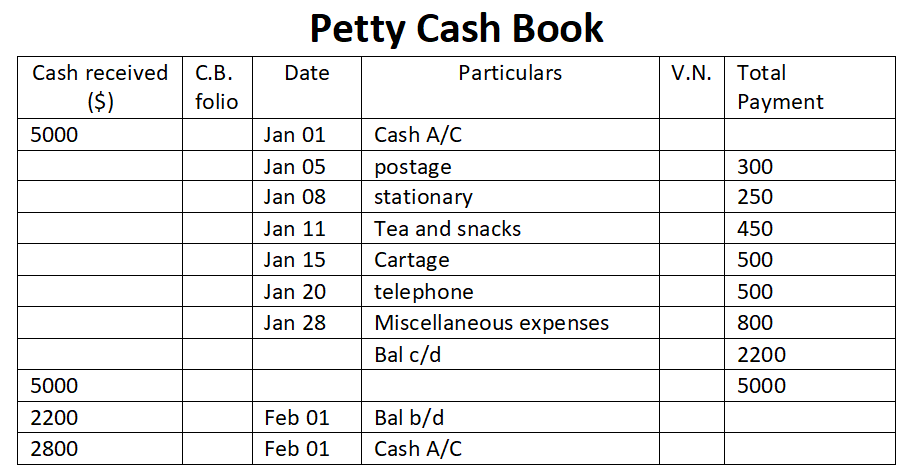
    Format for petty cash book

    Only small denominations are recorded in the petty cash book. It varies with the type, quantity, and need of a business. It involves cash and checks.


    • Ordinary Petty cash book:


    • Analytical Petty cash book:


    Conclusion

    A simple petty cash book is a type of cash book because it records the small expenses which involve small transactions in the ordinary daily business.

    A petty cash book is not as important as an income statement, balance sheet, or trail balance it doesn’t measure the accuracy of accounts so it is not treated as a statement.

    No journal entries are made in the books of accounts while spending or purchasing using a petty cash book so, it is not treated as a journal.


    See less
    • 0
    • Share
      Share
      • Share on Facebook
      • Share on Twitter
      • Share on LinkedIn
      • Share on WhatsApp

Sidebar

Question Categories

  • 1. Financial Accounting

      • Accounting Terms & Basics
      • Bank Reconciliation Statement
      • Banks & NBFCs
      • Bills of Exchange
      • Capital & Revenue Expenses
      • Consignment & Hire Purchase
      • Consolidation
      • Contingent Liabilities & Assets
      • Departments & Branches
      • Depreciation & Amortization
      • Financial Statements
      • Goodwill
      • Insurance Accounting
      • Inventory or Stock
      • Investment Accounting
      • Journal Entries
      • Ledger & Trial Balance
      • Liquidation & Amalgamation
      • Miscellaneous
      • Not for Profit Organizations
      • Partnerships
      • Ratios
      • Shares & Debentures
      • Source Documents & Vouchers
      • Subsidiary Books
  • 2. Accounting Standards

      • AS
      • IFRS
      • IndAS
  • 3. Cost & Mgmt Accounting
  • 4. Taxes & Duties

      • GST
      • Income Tax
  • 5. Audit

      • Bank Audit
      • Internal Audit
      • Miscellaneous - Audit
      • Statutory Audit
  • 6. Software & ERPs

      • Tally
  • 7. MS-Excel
  • 8. Interview & Career
  • Top Questions
  • I need 20 journal entries with ledger and trial balance?

  • Can you show 15 transactions with their journal entries, ledger, ...

  • What is furniture purchased for office use journal entry?

  • What is loose tools account and treatment in final accounts?

  • What is the Journal Entry for Closing Stock?

  • What is the journal entry for goods purchased by cheque?

  • What is commission earned but not received journal entry?

  • How to show adjustment of loose tools revalued in final ...

  • What is the journal entry for interest received from bank?

  • Following is the Receipts and Payments Account of Bharti Club ...

Hot Topics

Accounting Policies Accounting Principles Balance Sheet Bank Reconciliation Statement Bill of Exchange Branch Accounting Calls in Advance Capital Capital Expenditure Companies Act Compound Entry Consignment Creditors Current Assets Debit Balance Debtors Depreciation Difference Between Dissolution of Firm Dissolution of Partnership Drawings External Users Fictitious Assets Final Accounts Financial Statements Fixed Assets Fixed Capital Fluctuating Capital Gain Impairment Installation Interest Received in Advance Internal Users Journal Entry Ledger Loose Tools Miscellaneous Expenditure Profit Rent Rent Received in Advance Reserves Revaluation Revenue Expenditure Revenue Reserve Sacrificing Ratio Subscription Subscription Received in Advance Trial Balance Type of Account Uncalled Capital
  • Home
  • Questions
    • Most Visited
    • Most Active
    • Trending
    • Recent
  • Follow
    • Categories
    • Users
    • Tags
  • Write an Answer
  • Badges & Points
  • Request New Category
  • Send a Suggestion

Most Helping Users

Astha

Astha

  • 50,291 Points
Leader
Simerpreet

Simerpreet

  • 72 Points
Helpful
AbhishekBatabyal

AbhishekBatabyal

  • 65 Points
Helpful

Footer

  • About Us
  • Contact Us
  • Pricing
  • Refund
  • Forum Rules & FAQs
  • Terms and Conditions
  • Privacy Policy
  • Career

© 2021 All Rights Reserved
Accounting Capital.